


Lebanon's Space Industry, the First in the Region
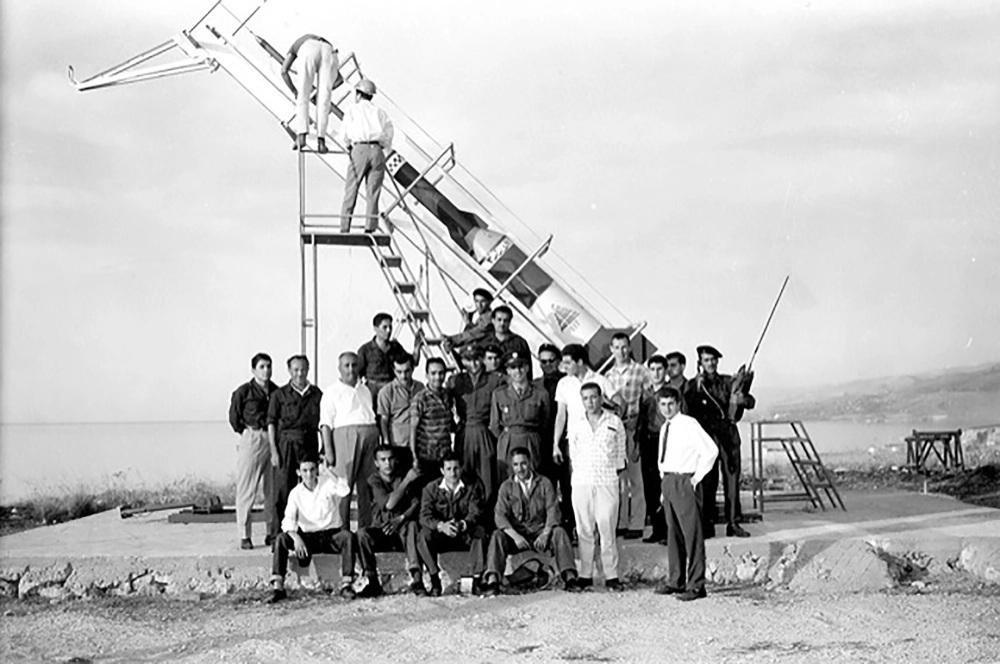
In the tense political climate of early 1960s Lebanon a small group of university students and their professor quietly began building roots. What started as a modest science club at Haigazian College in Beirut would grow into the Lebanese Rocket Society (LRS), launching solid-fuel rockets that reached the edge of space and briefly positioned tiny Lebanon as a surprising player in the global space race. This was a scientific endeavor that revealed the potential for a Lebanese space industry, that could have fostered aerospace research, advanced engineering education, and technological spin-offs. Yet it unfolded against a backdrop of low-level political maneuvering, military interest, foreign diplomatic pressure, and the ever-present fragility of Lebanon’s confessional political system.
Manoug Manougian, an Armenian-Lebanese mathematics and physics instructor who had studied in the United States, founded the Haigazian College Rocket Society in November 1960. With just a handful of students and almost no budget, they began experimenting with small solid-propellant rockets using basic materials. Early attempts were humble. Some rockets were pencil-sized, and many failed spectacularly. One early launch reportedly veered off course and landed near a church.
By April 1961, they achieved their first real success: a single-stage rocket reaching about 1 km altitude. Successive designs climbed higher, to 2 km, then much more. The rockets were soon named Cedar after Lebanon’s national symbol, and the group rebranded as the Lebanese Rocket Society.
National pride and quiet political support quickly followed. The project became front-page news and a rare source of unifying national excitement in a country where political power was carefully balanced among religious communities. President Fouad Chehab, the former army commander who had stabilized Lebanon after 1958 through cautious reforms aimed at strengthening the state and reducing traditional feudal influences, took notice. In 1962, he invited Manougian to the presidential palace and arranged limited government funding through the Ministry of Education. A postage stamp commemorating the Cedar IV rocket was even issued.
Military involvement added another layer of low-level politics. The Lebanese Army provided security for launches, granted access to ranges (including sites overlooking the Mediterranean near Dbayeh), and assigned Lieutenant Youssef Wehebe, a young ballistics expert, to assist. While Manougian and the students insisted the work was purely scientific, focused on education, research, and space exploration, the military saw dual-use potential.
This reflected broader regional realities: in a Middle East shadowed by Cold War rivalries, the 1958 crisis aftermath, and rising tensions (especially near Israel), any rocketry program carried security implications. Launch sites were sometimes adjusted due to concerns about proximity to Cyprus or Israel. Manougian later recalled suspicions of foreign monitoring, and received offers from other Arab countries to relocate and weaponize the program. Offers he firmly rejected, stating he was “trongly against violence of any kind.”
Achievements were impressive for a shoestring operation. The Cedar-3 (three-stage) and especially the Cedar-4 in 1963 reached altitudes of around 140 km, approaching the edge of low Earth orbit and the Kármán line that defines the boundary of space. Later launches, including the Cedar-8 in 1966, crossed into recognized space. These were the first rockets in the Arab world to achieve such feats. Launches drew crowds, journalists, generals, and diplomats, turning into public spectacles that boosted Lebanese self-confidence.The potential for a space industry was real. Continued funding and institutional support could have evolved the society into a national aerospace research center, trained a generation of engineers and scientists, and created spin-off technologies in materials, propulsion, and instrumentation. In a country known for its educated population and entrepreneurial spirit, it represented a genuine opportunity to move beyond banking and trade into high-tech sectors.Yet political undercurrents and practical setbacks derailed it. An accident in summer 1964 (during Manougian’s temporary absence) injured students when a dangerous propellant was used against instructions. More significantly, Manougian grew increasingly uneasy about the military’s growing role and the risk of weaponization. He departed Lebanon in 1966 to pursue further studies in the U.S.. One final launch (Cedar-10) occurred under army auspices afterward. Geopolitical pressures then sealed the program’s fate. According to accounts, Western governments (including the U.S., France, and UK) advised Lebanon to halt rocket activities amid rising regional tensions leading into the 1967 Six-Day War. French diplomatic influence, rooted in Lebanon’s historical ties played a role in urging restraint.
By the late 1960s, amid shifting politics under President Charles Helou and the gathering storm that would erupt into civil war in 1975, the story faded from public memory. Archives were lost or scattered, and participants emigrated. In a small, politically divided nation, a determined professor and his students proved that Lebanon could punch far above its weight in science and technology. The Cedar rockets showed the spark of a potential space industry that was just beginning to take shape before low-level political calculations, security concerns, and broader regional instability stopped progress. It remains one of the most remarkable and underappreciated chapters in both Lebanese history and the global story of space exploration.
Further reading/viewing: The 2012 documentary The Lebanese Rocket Society by Joana Hadjithomas and Khalil Joreige beautifully reconstructs this lost chapter. Manoug Manougian’s own recollections, preserved in interviews, continue to inspire.
Discussion 0 COMMENTS