


Expanding our reach to the solar system. Beyond a civilization on Mars, and a colony on the moon.
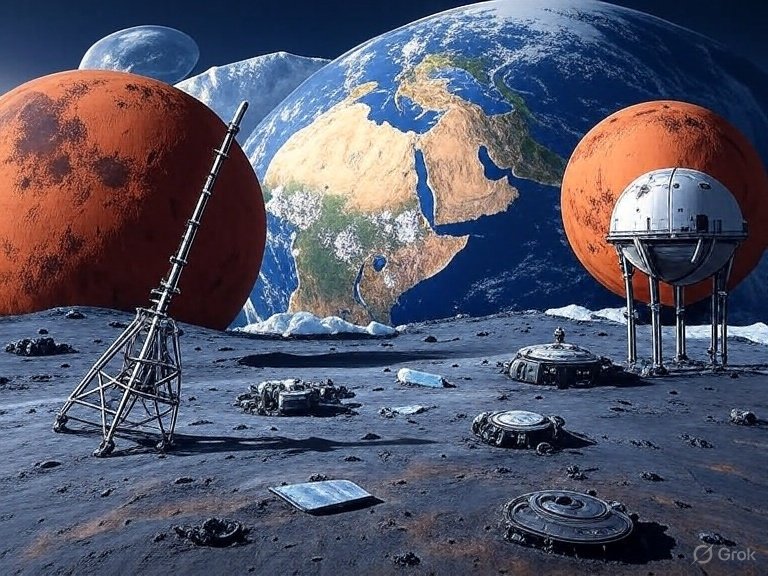
NASA’s Missions to Titan, Europa, Mars, and the Moon: Exploring Our Solar System’s Frontiers
Introduction: Earth as the Blueprint for Exploration
Earth, our vibrant home planet, is a unique oasis in the cosmos, teeming with life sustained by liquid water, a protective atmosphere, and a delicate balance of energy and chemistry. As humanity’s curiosity extends beyond our world, NASA’s ambitious missions to Mars, the Moon, Titan, and Europa aim to uncover whether similar conditions for life exist elsewhere in our solar system. These missions, rooted in decades of scientific exploration, seek to answer profound questions about the origins of life, the potential for habitability, and the geological diversity of our celestial neighbors. From the red sands of Mars to the icy oceans of Europa and Titan, and the familiar terrain of our Moon, NASA’s endeavors are pushing the boundaries of what we believe is possible in the search for life beyond Earth.Mars: The Red Planet in Focus
Mars, Earth’s closest planetary neighbor, has long captivated scientists and the public alike due to its potential to have once harbored life. NASA’s missions to Mars, including rovers like Perseverance and Curiosity, have revealed a planet that was once wetter and potentially habitable, with evidence of ancient riverbeds, lakes, and possibly an ocean covering one-fifth of its surface billions of years ago. Perseverance, launched in 2020, is collecting rock and soil samples in Jezero Crater, a site believed to have hosted a lake and river delta, to search for signs of ancient microbial life. These samples are part of the Mars Sample Return mission, a collaborative effort with the European Space Agency (ESA) to bring Martian material back to Earth for detailed analysis by the 2030s. Additionally, NASA’s Ingenuity helicopter, the first powered aircraft to fly on another planet, demonstrated the feasibility of aerial exploration on Mars, paving the way for future missions like the Dragonfly rotorcraft on Titan. Mars remains a priority due to its relative proximity and Earth-like features, with ongoing plans for human exploration through the Artemis program’s precursor missions, aiming to establish a sustainable presence by the 2030s.
The Moon: Humanity’s Stepping Stone
Earth’s Moon, our closest celestial companion, serves as a critical testing ground for NASA’s deep space exploration ambitions. The Artemis program, named after Apollo’s mythological sister, aims to return humans to the lunar surface by 2026, with Artemis III targeting a landing near the Moon’s south pole, a region rich in water ice. This mission builds on the success of Artemis I, an uncrewed test flight in 2022, and Artemis II, a crewed lunar flyby scheduled for 2025. The Moon’s water ice is a key resource for future missions, potentially providing water, oxygen, and even fuel for spacecraft. NASA’s Lunar Reconnaissance Orbiter and the Volatiles Investigating Polar Exploration Rover (VIPER) are mapping and analyzing lunar resources to support a sustainable human presence. The Artemis program also includes plans for the Gateway, a lunar-orbiting space station, which will serve as a staging point for missions to the Moon and beyond, including Mars. By mastering lunar exploration, NASA is developing technologies and strategies critical for deeper solar system exploration.
Europa: Jupiter’s Icy Ocean World
Jupiter’s moon Europa, one of the largest of its 90+ moons, is a prime target in NASA’s search for extraterrestrial life due to its subsurface ocean of liquid water, potentially twice the volume of Earth’s oceans. Launched on October 14, 2024, NASA’s Europa Clipper mission is en route to the Jupiter system, using gravity assists from Mars (March 2025) and Earth (December 2026) to arrive in April 2030. The spacecraft will perform 49 close flybys of Europa, coming as close as 16 miles (25 kilometers) to its icy surface, to investigate the thickness of its ice shell, the composition of its ocean, and its geological activity. Equipped with cameras, spectrometers, an ice-penetrating radar (REASON), and a magnetometer, Europa Clipper will search for signs of water plumes, measure the moon’s induced magnetic field to confirm the ocean’s presence, and map surface features like ridges and chaos terrains that suggest recent geological activity. The mission’s primary goal is to assess Europa’s habitability, determining whether it has the energy, chemistry, and liquid water necessary for life. Lessons from the Cassini mission to Saturn, which used similar flyby strategies, are guiding Europa Clipper’s design and operations, making it a cornerstone of NASA’s ocean worlds exploration program.
Titan: Saturn’s Earth-Like Moon
Titan, Saturn’s largest moon and the second-largest in the solar system, is a remarkable world with a dense nitrogen-rich atmosphere, thicker than Earth’s, and stable bodies of liquid methane and ethane, including lakes, rivers, and seas. NASA’s Dragonfly mission, set to launch in July 2028 and arrive in 2034, will deploy an eight-rotor rotorcraft to explore Titan’s surface, flying between dozens of sites to study its prebiotic chemistry and potential habitability. Dragonfly will leverage Titan’s low gravity and thick atmosphere to cover over 108 miles (175 kilometers), nearly double the distance traveled by all Mars rovers combined, with a final landing at the Selk impact crater, where organic compounds may have mixed with liquid water in the past. The mission builds on the Cassini-Huygens mission (2004-2017), which revealed Titan’s Earth-like hydrological cycle and subsurface ocean of liquid water and ammonia. Dragonfly’s instruments, including a neutron spectrometer, drill, and mass spectrometer, will analyze surface materials for organic molecules and biosignatures, offering insights into the chemistry that may have preceded life on Earth. Titan’s unique environment makes it a natural laboratory for studying prebiotic processes in conditions vastly different from our planet.
Conclusion: A Unified Quest for Knowledge
NASA’s missions to Mars, the Moon, Europa, and Titan represent a bold, interconnected effort to explore the solar system’s diverse worlds and answer fundamental questions about life’s origins and distribution. Mars offers a glimpse into a planet that may have once mirrored Earth’s early conditions, while the Moon serves as a proving ground for technologies that will enable deeper space exploration. Europa and Titan, with their hidden oceans and complex chemistries, push the boundaries of our understanding of habitability, challenging the notion that life requires Earth-like conditions. Together, these missions are not just about exploring distant worlds but about understanding our own planet’s place in the universe. By studying these celestial bodies, NASA is piecing together the puzzle of life’s potential across the cosmos, bringing humanity closer to answering the age-old question: Are we alone?
Discussion 0 COMMENTS