


Europa Clipper
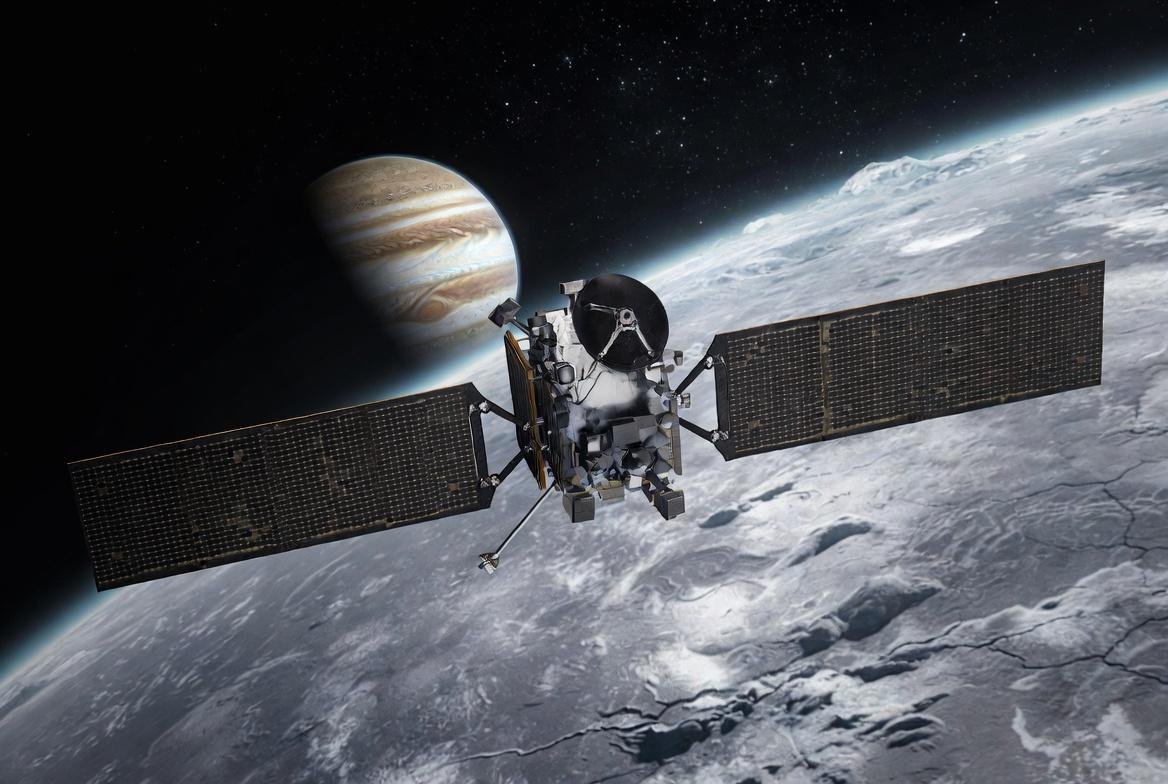

Mission Overview:
The spacecraft's primary goal is to investigate whether Europa has conditions suitable for life, focusing on its suspected subsurface ocean of liquid water beneath a thick ice crust. Scientists believe this ocean could contain twice as much water as all of Earth's oceans combined, along with chemical ingredients and energy sources needed for life.
Key science objectives include:
Characterizing the ice shell and underlying ocean (including their properties and any ice-ocean exchange).
Analyzing the moon's composition, surface chemistry, and any non-ice materials (possibly including carbon compounds).
Studying Europa's geology, surface features, and signs of current or recent activity (such as water plumes).
It is not a life-detection mission but will assess habitability by gathering data on water, chemistry, and energy.
Spacecraft and Instruments:
Europa Clipper is the largest interplanetary spacecraft NASA has ever built. With its solar arrays deployed, it spans about 100 feet (30.5 meters)—longer than a basketball court. It features a radiation-hardened vault to protect its electronics from Jupiter's intense radiation environment.
It carries nine science instruments plus a gravity experiment using its telecommunications system. These include cameras, spectrometers, radar, magnetometers, plasma instruments, dust analyzers, and more. All instruments operate simultaneously during flybys for comprehensive data collection.
Trajectory and Operations Launch:
October 14, 2024, aboard a SpaceX Falcon Heavy rocket from Kennedy Space Center.
Journey:
It travels ~1.8 billion miles (2.9 billion km), using gravity assists from Mars (March 2025) and Earth (December 2026) to reach Jupiter.
Arrival: Planned for April 2030.
Operations:
It will orbit Jupiter (not Europa, to minimize radiation exposure) and perform 49 close flybys of Europa, as low as 16 miles (25 km) altitude. These will scan nearly the entire moon over a prime mission of about 3.5–4 years (through ~2034).
Discussion 0 COMMENTS