


The Next Era of the Markets: Our Reach to Space, Space Connectivity, and Autonomy

The Space EcosystemThe modern space ecosystem is a complex, interconnected network of public and private players transforming from a government-dominated domain into a vibrant, multi-layered commercial-industrial system. Using frameworks like Seraphim SpaceTech’s 2026 Ecosystem Map, it is often described in three layers:Space Access — Launch vehicles, manufacturing, ground infrastructure, and supply chains (e.g., SpaceX Falcon/Starship, Rocket Lab, ULA).
Space Segment — Satellites, stations, in-orbit infrastructure, and services (communications, Earth observation, navigation, science).
Downstream — Applications on Earth: broadband, data analytics, positioning, defense, climate monitoring, logistics, and emerging in-space economy (manufacturing, tourism, resource utilization).
Key drivers in 2026 include NewSpace innovation (private companies), mega-constellations (Starlink and competitors), reusable launch tech dramatically lowering costs, and growing international/sovereign participation (US, China, Europe, India). Over 2,500 private companies and 70+ national agencies are active.
The ecosystem is maturing from rapid deployment ("how many things can we launch?") toward reliability, sustainability, security, and economic value creation.
The Space EconomyThe global space economy is a high-growth sector, currently valued at approximately $600–630 billion (2025/2026 figures), with commercial activity making up ~78% of revenues.
Growth Projections: Expected to reach $1.8 trillion by 2035 (World Economic Forum/McKinsey and others), with CAGRs of 7–9% in baseline scenarios.
Major Segments: Satellite communications/broadband (fastest growing), Earth observation, navigation (GNSS), defense/space security, launch services, and emerging areas like in-space servicing, assembly & manufacturing (ISAM), and space tourism.
Drivers: Reusable rockets (cost reduction), smaller/cheaper satellites, AI/data analytics, and dual-use (civil + defense) demand.
The U.S. remains the leader, but China and others are closing gaps in capabilities. The economy generates massive spillover effects — enabling industries worth many times its direct size through improved connectivity, navigation, and data.
The Next Era of Connectivity: Space ConnectivityWe are entering the era of ubiquitous, hybrid space-terrestrial connectivity. Low-Earth Orbit (LEO) mega-constellations like Starlink (thousands of satellites already deployed, targeting tens of thousands) are delivering high-speed, low-latency broadband globally, including remote/rural areas, aviation, maritime, and even direct-to-cell (phone) service.
Key Shifts:From geostationary (high latency) to LEO (fiber-like performance).
Integration with 5G/6G terrestrial networks for seamless coverage.
Massive capacity growth enabling new applications: real-time global data, IoT ("Internet of Space Things"), edge computing in orbit, and resilient infrastructure against terrestrial outages.
Economic Impact: Unlocks productivity in underserved regions, supports remote work/education/healthcare, and powers data-intensive industries (AI, autonomous systems, logistics).
This is the foundation for a truly global digital economy — often called "rebuilding the internet in space."Mobility (Autonomous) and Its EvolutionAutonomous mobility refers to self-driving vehicles, robotaxis, autonomous trucks/drones/EVTOLs, and integrated multimodal transport. It is progressing toward Level 4/5 autonomy (high/full automation) in controlled environments, with broader rollout expected in the 2030s.
Transformations:Efficiency Gains: Reduced accidents, optimized routing, platooning (fuel/energy savings), higher vehicle utilization.
Shared Autonomous Vehicles (SAVs): Could dramatically shrink fleet sizes (one SAV replacing 10+ private cars in urban settings), reduce parking demand, and free land for other uses.
Synergies with Space: Satellite PNT (positioning, navigation, timing — e.g., GPS/Galileo), Earth observation for mapping/traffic, and space-based connectivity for real-time data and remote operations.
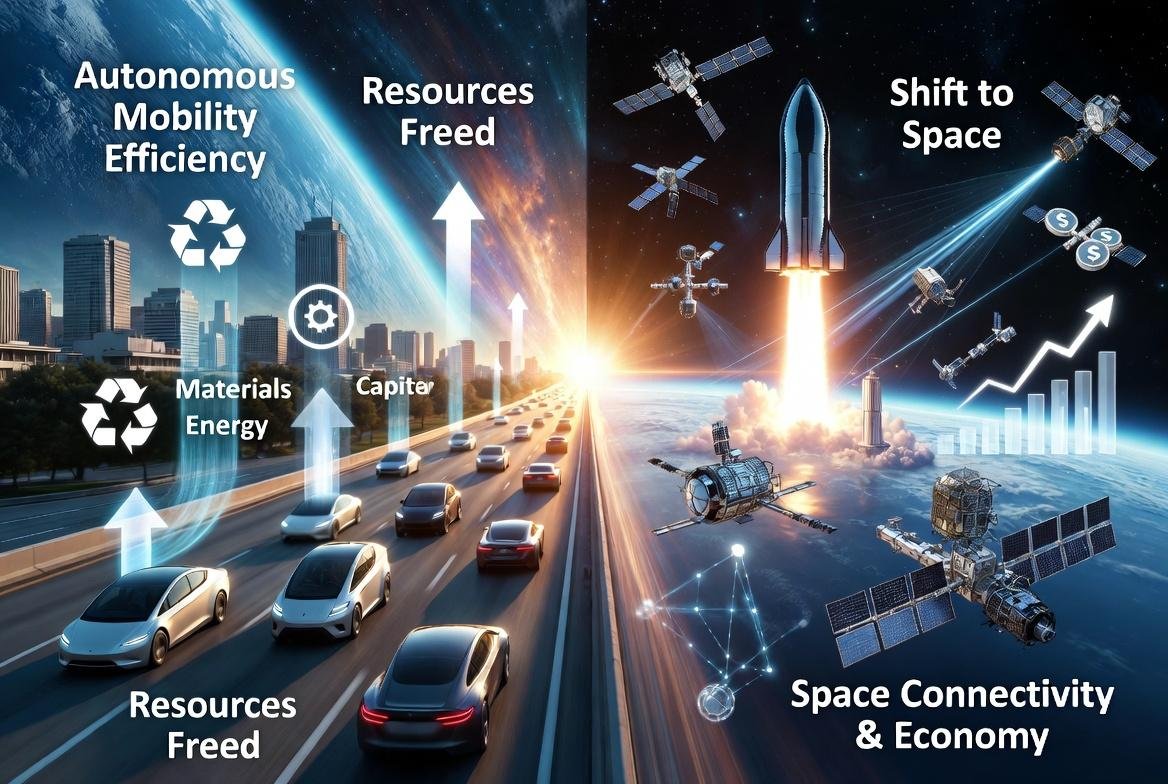
Minimizing Production Resources for Mobility → Shifting to SpaceThis is a critical resource reallocation dynamic:Terrestrial Mobility Optimization: Autonomous + electric/shared vehicles reduce the total number of vehicles needed, lower manufacturing demand (fewer cars produced overall), decrease parking/road infrastructure needs, and improve energy efficiency. This frees up capital, materials (steel, rare earths, batteries), labor, and land that were previously locked into high-volume, low-utilization personal vehicles.
Capital & Talent Shift: Efficiency gains in mobility (and broader terrestrial industries via space data/connectivity) generate economic surplus. Investors and companies redirect this toward high-growth frontiers like space — where returns on launch tech, satellites, in-space manufacturing, and exploration are accelerating.
Virtuous Cycle: Space tech (connectivity, navigation, EO) makes autonomous mobility safer/more efficient → mobility efficiencies free resources → more investment flows into advancing space capabilities → further terrestrial benefits.
In essence, maturing autonomous mobility acts as a resource liberator, allowing humanity to redirect productive capacity from "moving stuff on Earth redundantly" toward "expanding reach into space." This supports long-term goals like sustainable development on Earth while building the multi-planetary future.
Sources:
seraphim.vc
investing.com
nova.space
orbitalradar.com
weforum.org
setr.stanford.edu
starlink.com
weforum.org
stellarix.com
pmc.ncbi.nlm.nih.gov
www3.weforum.org
autosinnovate.org
weforum.org
Discussion 0 COMMENTS