


Industry Recap - September 2026
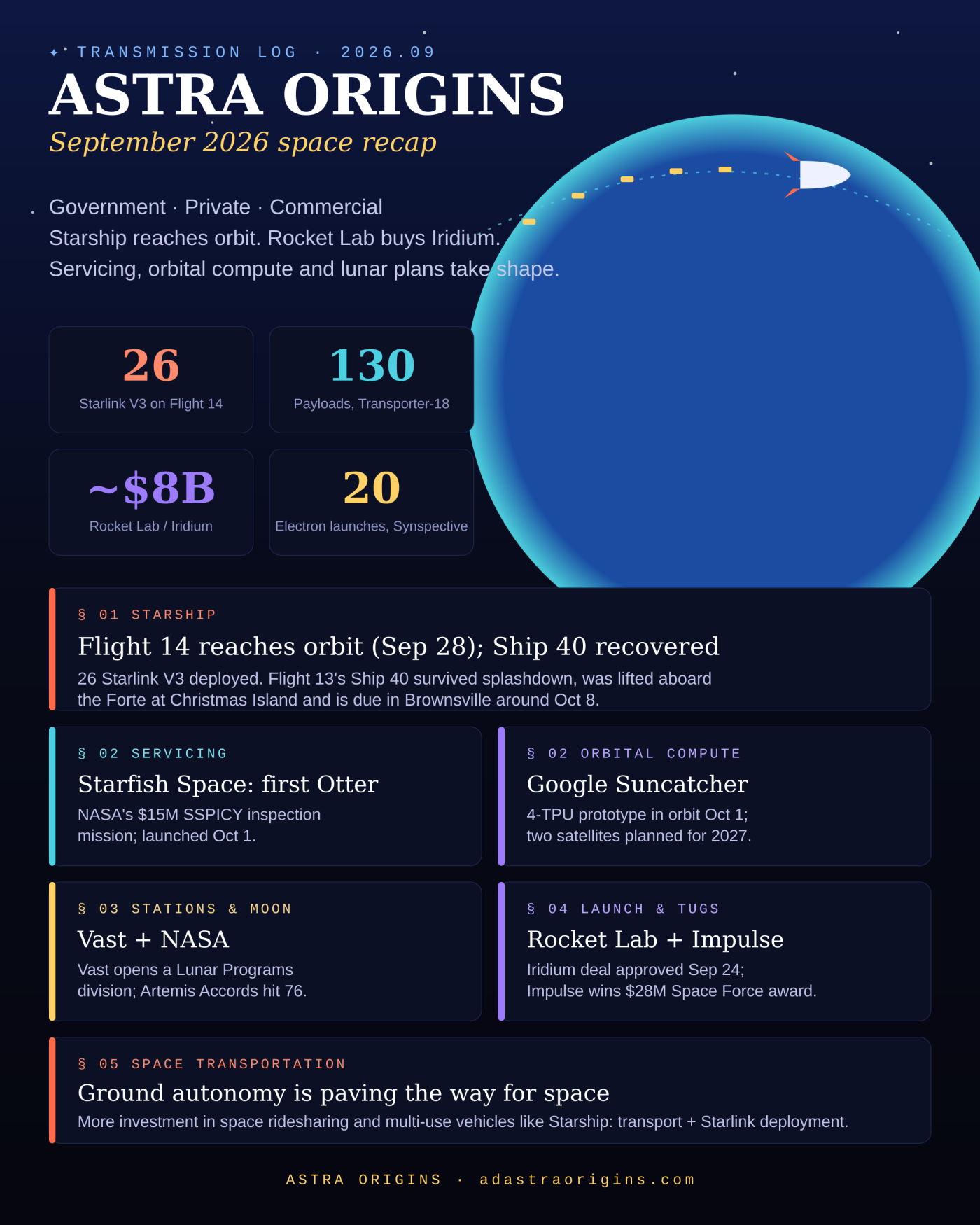

September closed the month Starship first reached orbit, Rocket Lab’s Iridium acquisition cleared its shareholder vote, and the first full-scale satellite servicer and the first Google AI-chip satellite were readied for flight. The October 1 launches that followed, Crew-13, Transporter-18, and a Falcon Heavy flight, on a private mission.
The headline numbers capture the scale. Flight 14 carried 26 Starlink V3 satellites. Transporter-18 lifted 130 payloads on a single Falcon 9. Rocket Lab’s pending Iridium deal is valued at roughly $8 billion. Electron’s Synspective relationship now covers 20 launches. The Artemis Accords stand at 76 signatories. Impulse Space added a $28 million Space Force award.
Starship: first orbit, and a ship coming home
On 28 September, Ship 41 and its Super Heavy booster lifted off from Starbase and became the first Starship to enter orbit. The ship deployed all 26 Starlink V3 satellites—SpaceX has described one such load as roughly ten times a Falcon 9 launch of V2 Mini satellites, with each V3 around 1 Tbps. One of the ship’s six engines shut down on ascent. Controllers waited about 20 minutes before committing to the orbital insertion burn. The vehicle then left orbit early and splashed down in the Pacific. Accounts differ on whether the flight lasted about two hours or about three, against a planned ten. Three of the satellites carried cameras to inspect the heat shield in flight. Hardware for Flight 15 (Ship 42) is already in build.
The recovery story belongs to the flight before. Flight 13 flew on 24 July and placed 20 Starlink V3 satellites on a suborbital arc. The booster failed its landing burn. Ship 40, however, splashed down intact in the Indian Ocean—a first for the program. After 24 days at sea it reached Christmas Island. Boskalis’s semi-submersible Forte lifted it aboard and departed around 28 August, with tracking data pointing to a Brownsville arrival near 8 October. SpaceX has said the return will take several months; the arrival date comes from ship tracking rather than a company statement.
Servicing and orbital compute
Starfish Space used 23–24 September to show that its first full-scale Otter is built and has a customer. The 335 kg vehicle marks the shift from demonstration craft to operations. It flies NASA’s $15 million SSPICY mission, closing autonomously to within hundreds of meters of dead U.S. satellites to measure spin and surface condition, with a mission life of up to two years. It launched on 1 October aboard Transporter-18.The same rideshare carried Google’s Project Suncatcher prototype. Built with Planet, the refrigerator-sized satellite holds four TPUs. Google has confirmed contact. Over the coming weeks the flight will test how those chips handle launch stress, radiation, and thermal extremes. The company calls it a minimal test. Two more satellites are planned for 2027. SpaceX has said it expects orbital AI-compute satellites as early as 2028.
Stations, the Moon, and government
Vast stood up a Lunar Programs division on 23 September, before Haven-1 has flown. The division targets NASA’s Moon Base with a Haven-derived airlock, solar power stations, a multi-module habitat, and lunar communications and navigation satellites. Haven-1 remains in final integration for a 2027 launch. On 9 September, ESA signed Vast for the first Greek astronaut mission, part of the sixth private astronaut mission to the ISS.
On the government side, the Artemis Accords reached 76 signatories as Albania, Croatia, Côte d’Ivoire, and San Marino joined. On 30 September NASA selected three PRISM payload suites for CLPS landers. Artemis III is targeted as soon as mid-2027 as an Orion docking test with Blue Moon and Starship. Golden Dome is aimed at operational capability by summer 2028. Douglas Schiess became Chief of Space Operations. Crew-13, slipped from 12 September, launched on 1 October. The Air & Space Forces conference that opened on 14 September was dominated by Golden Dome and Space Force topics.
Rocket Lab and Impulse Space
Iridium shareholders approved Rocket Lab’s acquisition on 24 September, with about 99.6 percent of votes cast in favor. Closing is targeted for mid-2027. The deal sits on top of a string of earlier buys—Sinclair, Planetary Systems, SolAero, ASI, GEOST, Mynaric, and Motiv—with Iridium still pending. Rocket Lab flew four Electron missions in September, including its 97th, and on 30 September signed its largest Electron commercial contract: 20 launches for Synspective. Neutron’s debut is still aimed at late 2026, though that date is unconfirmed.
Impulse Space spent the month proving the last-mile tug. On 8 September it reported that two Mira vehicles had passed within 200 meters of each other using Impulse’s own navigation, without partner software. On 22 September it won a $28 million Space Force space-domain-awareness contract that adds a Mira mission hosting an MIT Lincoln Laboratory payload, no earlier than 2029. Backlog stands at about $200 million across more than 30 contracts. Next up are the Helios first flight, still aimed at late 2026, and LEO Express 4 on Bandwagon-5, no earlier than October.
Rideshare and the transport shift
The ground analogy is direct. Autonomy in terrestrial transport has built the confidence, capital, and customer habits that space transportation now draws on. That shows up as rising investment in space ridesharing and in multi-use vehicles such as Starship, which flies both as a transport system and as the deployer of Starlink V3 satellites.
Transporter-18 carried 130 payloads on one Falcon 9 on 1 October. SpaceX has now flown more than 1,800 rideshare payloads. Brokers Exolaunch, D-Orbit, SEOPS, and Maverick handled customers on the mission. Tugs such as Mira and Helios then move individual payloads to their own orbits. Otter and Mira already rendezvous on their own. Underneath that stack, Starship is the step change: Flight 14 placed 26 Starlink V3 satellites in a single launch.
Discussion 0 COMMENTS